Mississippi Watershed Past, Present, and Futures
“When prices are high, we want to farm the heck out of our lands and we do less conservation. It should be the opposite. When prices are high—because the pressure on the environment is high too—we should do more conservation.”
A conversation with Professor Silvia Secchi (University of Iowa) about the Mississippi River watershed, its sociohydrology, and visioning alternative futures. Released October 9, 2026.
guests on the show
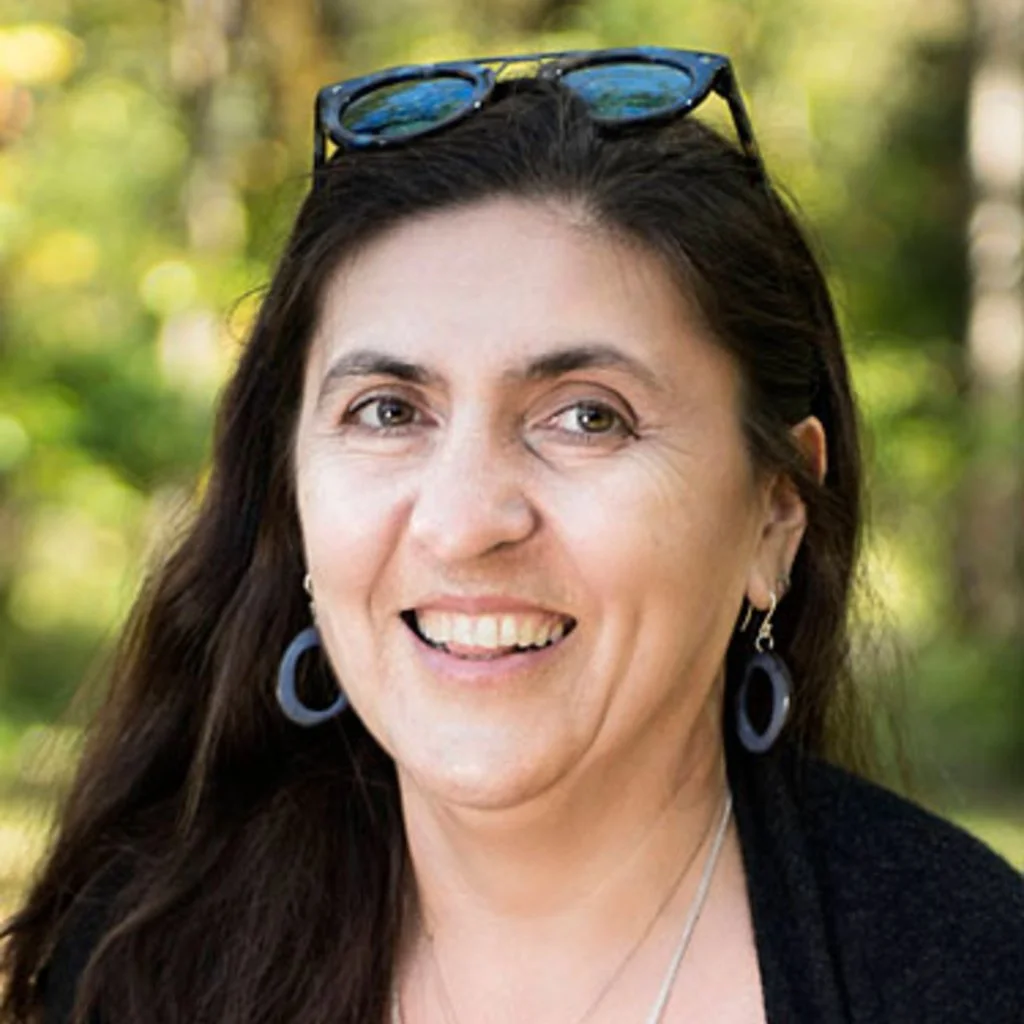
Silvia Secchi
Silvia Secchi is a Full Professor in the School of Earth, Environment, and Sustainability at the University of Iowa. Professor Secchi identifies as an economist, a geographer and a transdisciplinary scholar. Professor Secchi studies the nexus between humans and the environment, the tools and methodologies we use to understand it, the policies we adopt to change it, and the pedagogy of teaching it. Most of her work focuses on the Mississippi River Basin–land-based energy production, water quality, adaptation to climate change, floodplain management, invasive species and farmers’ attitudes in the watershed.
TRANSCRIPT
Mallika Nocco
Hello, Water Talk listeners. We are going to be talking about the Mississippi River and the Mississippi River watershed today, also known as the Great River. Before we get going, we just wanted to provide a little bit of information about the Mississippi River. It drains 41% of the land area of the United States.
It is considered, and I just learned this from Sam, a transboundary basin because some of the headwaters actually start in Canada. That was a little hard for me to hear as a Minnesota educated kid, because I always claimed those headwaters when I was growing up in Minnesota, but some of them do start in Canada. We did confirm that. And there are 32 states in the Mississippi watershed. So it is expansive. You will hear it referred to by Professor Secchi as the lungs of the United States.
The other thing I wanted to mention is we really freely use the term wicked problems. Wicked water problems are problems that don't have straightforward, easy solutions. The solutions to wicked problems are considered to be messy solutions, and it takes us a while to try to figure out what these solutions might look like. So wicked problems are actually an area of study.
Faith Kearns
The other thing I would add that I always like to urge people to think about is that we can really get into thinking about the Western US as water scarce and the Midwest as extremely water rich. But as water quality impacts become more clear, you really have to think about water quality in many ways as a water supply or water quantity issue, too, right? You can have an abundance of water, but if the quality is terrible, you actually are facing a supply problem as well. So it's not so straightforward as "there's so much water in the Mississippi, and there's none out west."
Mallika Nocco
And it relates back to the human right to water, right? The quality of that water is a part of the human right to water. So that's such a great point to make.
To that, we wanted to talk about this term called hypoxia. Hypoxia means oxygen depletion, and it's this environmental problem where the oxygen in water decreases to a level that can't support living aquatic organisms: fish, shrimp, different types of aquatic creatures. Hypoxia in the Gulf of Mexico has been defined as a concentration of dissolved oxygen that's less than 2 ppm. So this is a pretty big problem.
Sometimes people will refer to Gulf hypoxia as the dead zone in the Gulf. People will talk about the dead zone or many different dead zones in the Gulf. The hypoxic zone in the Gulf of Mexico is very much related to the practices and to the different human uses, specifically agriculture, in the Mississippi River watershed. So you'll hear us talk about Gulf hypoxia and agriculture as an interlinked problem, and it's because it is an interlinked problem. What basically happens is nutrients are exported down the Mississippi into the Gulf, and those nutrients are what causes this hypoxia. I think we covered everything.
Okay, let's talk with Professor Secchi about the Great River. In today's episode, we are talking about the Mississippi River watershed and the Great River with Professor Silvia Secchi at the University of Iowa. Professor Secchi is a full professor in the School of Earth, Environment, and Sustainability and identifies as an economist, a geographer, and a transdisciplinary scholar. Professor Secchi studies the nexus between humans and the environment, the tools and methodologies we use to understand that nexus, and also the policies that we adopt to change it and the pedagogy of teaching it. Most of our work focuses on the Mississippi River basin and land-based energy production, water quality, and adaptation to climate change, as well as floodplain management, invasive species, and farmers' attitudes in the watershed. Silvia, welcome to Water Talk.
Silvia Secchi
Thank you so much for having me. I'm delighted to be here.
Samuel Sandoval
Hey, ciao Silvia. Before we start the podcast, we provide a little of the background of the Mississippi River and the challenges related with hypoxia in the Gulf of Mexico. I know that this is a really wicked problem. Can you elaborate with us and our audience about this problem from a transdisciplinary perspective?
Silvia Secchi
This is a really, really big question, right? We could spend months unpacking it. I would say a couple of things are really important to me. One is that, for me, the Mississippi is like the lung of the United States. The health of the river watershed, from the Missouri to the Ohio, is really reflective of a lot of problems: from industry, from agriculture, from urban development. A lot of stuff gets put on this river and impacts its health.
Different parts of the watershed have different problems. In some places you have water quantity, in some places you have water quality, in some places you have agriculture, in some places you have flood management structures. That's why it's a wicked problem: it's got so many stakeholders. The second reason it's such a wicked problem is that we have modified this river for a very long time, and at this point we realize that some of the modifications we have made are no longer fit for purpose.
We have really focused a lot on navigation in the river to the detriment of a lot of other ecosystem services. We have ignored a lot of the traditional uses of the river by the native populations that lived around it. And when I say the river, I mean the whole watershed. I'm talking about the Red River, the Atchafalaya, the Ohio, the upper Mississippi. The river system was being managed before white settlers came, but it was being managed without really forcing it to do things that would have, as wicked problems have, a lot of cascading effects. So we have this historical trajectory.
Personally, one of the other issues that I see, and why it's a wicked problem, is that very often for regulatory purposes this is framed as the hypoxia problem, but it really is a whole body problem. The water that is polluted down in the Gulf of Mexico because of what is happening upstream is also impacting human and non-human health upstream. I think we've been conditioned, because of the way the policies have been written, because of the way the Hypoxia Task Force, it's even in the name, right, has operated, to think about upstream and downstream, rather than thinking that in each place, what we're doing to the river has local impacts that are not necessarily good impacts.
In Iowa, I think we're starting to see this because in the last couple of years there's been an increased attention to the issue of human health, in particular high cancer rates that are associated with multiple issues, but agriculture is one of the premier ones. So it's no longer what is happening to shrimp fishers in the Gulf; it's also what is happening to our health, to our groundwater, to our drinking water sources here in the heartland.
Faith Kearns
Thank you so much, Silvia. I first want to say the Mississippi is so cool. I'm such a westerner. I was born and raised in Arizona, and our rivers are quite a bit smaller. But the first time I saw the Mississippi, you just really do feel this kind of awe about it. I especially remember visiting the upper Mississippi and just how beautiful it is, the bluffs and all of that. So I just want to admire your river.
You've touched a little bit on agriculture, which is obviously a huge land use in the Mississippi watershed. Can you talk a little bit about this concept of agro-extractivism as it's related to conservation and environmental outcomes? What does the term mean, and how has extraction evolved with conservation efforts?
Silvia Secchi
I'm not trained as a historian, I'm trained as an economist, but I think it's extremely important that we understand the historical roots of our current problems, whether they're social problems, environmental problems, justice issues. From my perspective, the Mississippi River has really borne the brunt of the practices of westward expansion. Iowa and Kansas are the states in the Union with the least amounts of public land. That's because when they were settled, with that township-range, land office kind of mapping, all the land was allotted. And it was allotted in squares, which, if you know anything about how water flows, doesn't make any sense, right? The water doesn't follow the grids.
Mallika Nocco
I feel like we should pause and just reflect on that for a moment. It seems silly, but every once in a while we talk about boundaries on our podcast, and how humans draw boundaries, and water does not adhere to those boundaries, especially when they're in little squares. So thank you for reminding us all about that.
Silvia Secchi
And that's one of the symptoms of this agro-extractivism, but it is also one of the defining characteristics of our management system these days, still. The idea of manifest destiny and westward expansion is that we're going to create all these squares, and we're going to put white people largely in all these squares. In Iowa, we had Black Code laws that basically forbade Black people from settling in the state. That's why agriculture in the Midwest is largely white. And we are going to farm in very non-native ways, in the sense that we're going to import these technologies, these approaches, even some of these crops, from Europe, that do not necessarily work with nature.
So there was a lot of working against nature. I think Kansas is a better example than Iowa, because in Kansas dryland farming proved to be impossible, not non-feasible, non-sustainable, way before the Dust Bowl of the 1920s. There were dust bowls in Kansas before, and that's because they were allocating these pieces of land without working with the rain, without working with the rivers. Farmers were farming in ways that were basically linked to larger production systems. You had the railroads, you wanted to export these products for markets. So I think the roots of our current problems, where we produce so much corn that we have to come up with ideas like ethanol to use it up, come from this history: a history of working against nature rather than with it, a history of not listening to native practices, native knowledge of this land.
To me, we started extracting then, and we're still extracting, in the sense of how we mine our soils today, the last bit of profit. Faith, you asked about the links with conservation. I think the best example I can give of that is how our conservation activities go down when prices are high. From fence row to fence row in the 1970s to the ethanol boom, we reduced a lot of our conservation acreage in the Conservation Reserve Program. When prices are high, we want to farm the heck out of it and we do less conservation. It should be the opposite. When prices are high, the pressure on the environment is high too, so we should do more conservation. You can really see that agro-extractivism in action when we have these high-stakes waves coming in, and conservation retracts and extraction advances.
Samuel Sandoval
I'm seeing a lot of these stories repeated in other parts. I'm not sure, Silvia, if you can characterize or provide characteristics of agro-extractivism, because I'm reflecting on California and Maine. I'm thinking the same. And I'm thinking also Texas and Maine, the same, and other parts of the Colorado River. Would you mind providing some characteristics so that, at a bigger picture, we can see where we fall in our different places and regions?
Silvia Secchi
Certainly. I think here's where the 100th meridian divide in this podcast is happening. I rarely think about water quantity, but I think a lot of the extraction in the West is related to water, because water is the scarce resource. If you're thinking about the Colorado, if you're thinking about the Central Valley, if you're thinking about Texas, the extraction is literal water extraction.
Mallika Nocco
That's what I was thinking, and we're not even trying to hide it. That's actually the exact scientific term we use for what we're doing when it comes to water quantities. We call it extraction. But it sounds like you're going... I think I know where you're going, but how do we think about extraction in that more water quality frame that you're thinking of?
Silvia Secchi
Well, in that framework, the extraction is in terms of the health of ecosystems and the health of humans. Yes, we treat the water we drink, but not if you're on well water. If you're on well water, you're literally drinking those pollutants unless you do something about it. But we don't really have institutional mechanisms at the federal level to address that. Each state is doing something, but not very much. And then we're extracting in terms of soil, in terms of ecosystem health, in terms of habitat. So for both human and non-human nature, we have impacts.
Mallika Nocco
Yes, thank you so much for this. This is so interesting. This is something that I struggle with. We've talked a lot on our podcast about how there are these challenges with the land grant system, with our history, the connections that land grant has to settler colonialism. And we are also very much tied to the land grant system. We're working in extension. This is a cooperative extension podcast, and we're trying both to constructively criticize the system that we're in, but then also work within the system and form partnerships with farms and farmers who are also in this extractivist framework. I'm curious if you could help us think through some of the ways in which we can be critical, but also exist and form these partnerships with farms and farmers and make it authentic to try to address some of these environmental issues in the Great River's watershed. Well, first of all, we're asking you the tough questions.
Silvia Secchi
That's totally fine. I don't know if you guys know, but I am myself a product of the land grant system, because I'm a graduate of Iowa State University. Even though I now work at a public flagship that's not a land grant, I worked at Iowa State for eight years after I graduated. So this is very close to my heart. For me, what is really important is to do exactly what we're doing here, which is to be honest and acknowledge all these problems. For too long, and in some places still, we are not admitting these legacies. We're not admitting these responsibilities. I think the first step in a reparation kind of system is to acknowledge that these injustices have occurred, that there are these structural biases, that there are these legacies. If we don't do that, it becomes much harder for the next generation of people who are going to do our jobs to move it forward.
I got my PhD at Iowa State in 2000, so a quarter of a century ago, and I've seen a lot more awareness, a lot more self-awareness, from people like us. Like this very conversation: we are much better able to situate ourselves within the system and understand the system, its impacts, its history. And so for the people who work within institutions, you just push from the inside, right? And you say, this is not good. In Iowa, we don't have any native reservations. What we have is the Meskwaki settlement, and the Meskwaki had to buy back their land after being pushed out. So it's rethinking this history and its problems, acknowledging them, and respecting what has been lost and the voices of those who have lost in this long-term process.
The land grant universities were created after the Morrill Act of 1862. The institutions in the eastern part of the United States actually received what is called scrip, which basically means they were given land elsewhere, in the West. Rutgers got land in Iowa, for example, because New Jersey was settled. So acknowledging this history and the benefits the universities have received from these systems, and thinking about how to address these inequities, to me is how we move forward.
Faith Kearns
If I could just say something real fast, it's a really interesting time right now, because I'm seeing a lot of calls for reinvestment in public education, public universities, as the response to the crisis, or whatever we want to call it, that universities are in right now. One of the things that comes up a lot is reinvestment specifically in the land grant system. So it feels like a really important conversation to have right now. Even on Bluesky this morning, there was a specific thread about the Morrill Act and the land grants. If there is an opportunity for reinvestment in that system, then we should really try to figure out the way forward based on this painful history. It was interesting to see the number of people popping on to say, I have mixed feelings about this, particularly Indigenous people, Indigenous scholars, saying, yeah, I'm a product of this system and I have feelings about it. So it just feels like a really important conversation right now, and I appreciate it.
Mallika Nocco
Yes, very much. I like your perspective a lot of having these conversations and putting tension on the system that we're in and not just being complacent within it. It's helpful for me to hear.
Silvia Secchi
Thank you for that. Well, you put more pressure on once you have tenure than before you have tenure. And you put more pressure on when you're a full professor than when you are an associate professor. That's what I do. I don't think I'm going to win any popularity contest in my state, but what I do is I push. The social capital is for using, not for saving.
As I was thinking about this podcast, I have lived all my life in the United States. I came here in 1996 in the Mississippi River watershed. That was at Iowa State, in the upper Mississippi River watershed. Then I was in Carbondale, which is in the middle Mississippi watershed. And my husband is a citizen of the Shawnee tribe, and so we plan to retire in northeastern Oklahoma, on the lower Mississippi. I feel like I owe it to the river, to be honest. The river demands it.
Mallika Nocco
That is such a beautiful sentiment and way of thinking. To shift gears a tiny bit, I loved reading about your work on counting, related to just who counts as a farmer, because you took something that I think most people would think of as being a relatively dry topic, like counting the number of farmers in the United States, and you really make it very interesting by adding all of these layers of information on it. Some of the work you've done is around who counts as a farmer from a gendered perspective. How are we counting women farmers? And also how we are characterizing and defining farms themselves, which is related to who gets to be considered a farmer. I was wondering if you could tell us a little bit more about the value of these statistics and these definitions, and also how they impact the way in which we're thinking about agriculture and water, especially in the Mississippi watershed.
Silvia Secchi
Counting is a political activity: who you count and who you don't count. When I started doing this over a decade ago with Caroline Gottschalk, who used to be in Wisconsin, right?
Mallika Nocco
And has been on our podcast.
Silvia Secchi
There you go. I was really surprised that we did not count women farmers until 1978. What that means is that implicitly we assume the farmers are men. We certainly were not assuming the farmers were women in the 1960s. Similarly, until the beginning of the new millennium, we were not counting native farmers on reservations. The reservations are in fact considered, literally, that's the term, abnormal farms. So you counted them as one operator. Not counting versus counting, and how you change the definitions, is really a lens through which you can see power dynamics and gender dynamics. Sometimes what is really important is what is not there. That paper came out in 2014 with Caroline, so it started well over a decade ago.
The other thing that happened is that I started to realize that, besides these gender differences, there is how political the definition of what is a farm is, because the definition has not changed since 1974. In part, not to change the definition from 1974 to today... in the 90s we moved the Census of Agriculture from the Census Bureau to USDA, and one of the reasons to do that was that it was thought that USDA would be more friendly in how it approached the census and counted farmers. So today we count as farmers people who are only farmers because there are tax benefits to it, and people who are only counted as farmers because it helps USDA have a larger constituency. This hides how much concentration and shrinking of the farm population there has actually been.
Going back to the theme of not counting: while we overcount to some extent, or we really pay a lot of attention to farmers, we don't do the same thing with farm workers, who are extremely important. In irrigated systems, high-value specialty crop production systems, a lot of the activities on farm depend on farm workers. We have lots of evidence that these people are under a lot of stress and pressures, underpaid, targeted by immigration these days, with little access to health insurance, all sorts of problems, and we don't count them, or we don't count them well enough to have a clear idea of who they are.
The other people we don't count, because it might be embarrassing to find out about them, is landowners. Forty percent of US farmland is not owner-operated, and a lot of these landowners are non-operating landowners. They don't actually farm their own land. They're somewhere else, they're retired, they get the money out of a trust, something like that. So again, the way we highlight and center farmers goes back to this idea of farmers as the salt of the earth, this manifest destiny, the yeoman farmer in Jeffersonian terms, and we gloss over who actually these farmers are. Are these farmers women? Are these farmers minoritized? Why are there not many minoritized farmers? What are the historical reasons for that? And we don't count the other people who actually are really important in farming, the farm workers, the landowners. So again, it's a lens through which to see power dynamics and narratives within agriculture.
Mallika Nocco
Yes, that's so interesting. And I was also thinking, as you were talking about the time frame and the "we" and who the "we" is, the "we" that's counting has changed too, and maybe it took a change in who's doing the counting to start to unveil some of this.
Silvia Secchi
Also, how we define who we are counting sets the agenda. That is something that we have not discussed, because counting comes with the power of, yes, I'm a farmer, and with that label I can lobby. And that's extremely important.
Faith Kearns
It reminds me also that a colleague and I, a few years ago, were pursuing an internal study on another piece of this, which is how much say extension folks have in who their clientele actually are. That was a part that we really started to notice from the extension side: who has leeway, or who feels like they have leeway, and who doesn't, to say, who do we serve as extension? Which is very much related to all of the questions you're talking about. If a female farmer isn't considered a farmer, how do they get counted as somebody who gets support from extension? So, lots of interesting stuff there.
Silvia, your work has also drawn parallels between agricultural water quality programs and policies that started in the 70s and emerging strategies for thinking about climate change mitigation in agricultural systems. How are these two challenges, water quality and climate change, different? And what do you know about what works and what doesn't?
Silvia Secchi
That's a really big question. When I started thinking about this, it was during the Biden administration, and there were a lot of efforts into climate-smart agriculture, so I thought that there was a lot more that we could do. Unfortunately, now the bar is much lower, because even those little things we were doing before are disappearing. A lot of these climate-smart grants have been canceled or restructured in ways that likely mean they're basically passed through for subsidies rather than developed with a concern for climate.
I think our long history of conservation, from the first farm bill in the 1930s, is a history of voluntary approaches that again ebb and wane. When we need to go fence row to fence row, we forget about conservation. We did make really terrific inroads when it comes to one specific water quality problem, which was soil erosion. Soil erosion had been a problem from settlement on, because the way we were tilling, the way we were growing crops, with no cover crops in the winter, was very, very problematic.
In 1985, when we passed conservation compliance in the farm bill, we really made some real changes. We saw that in the water: water quality got better in terms of sediment, and it got worse in terms of nutrients, because that was also the time that confined animal feeding operations were booming. There was much less attention to the circularity of farming systems. So we kept adding artificial fertilizers, the manure became more and more of a waste product, and it added to these nutrient loads. We did not address it. And now I think what we're doing with climate is very similar to what we have been doing with water, and not adequate.
I think there needs to be what we call in the business cross-compliance. You get access to subsidies, but you have to do something on the environmental side, just as in the case of conservation compliance. And there needs to be consistency in the policies. You don't give up on land retirement programs when prices are high. You do them in a maybe more targeted way, but you have to have permanence of these programs, and they have to be robust to changes in prices. That is true for water, but it's also true for climate, because if you're planting trees or grasslands to sequester CO2, you have to do that when prices are high as well. You have to protect those areas. If the choice is to do other activities, those activities also have to be stable. So the funding cycle is not a friend of conservation, whether you're talking about conservation for water or conservation for greenhouse gas emission mitigation. And I think we haven't learned that.
When you look back, in times of crisis we do conservation, because conservation also serves a purpose of income support for farmers. But when the cows are fat and you don't need to support income for farmers, like post-World War with the Marshall Plan, the 1970s, and then the ethanol boom starting in 2008, we don't need the income support, and so we drop a substantial part of our conservation agenda. That's not how grown-ups should do policy.
Samuel Sandoval
And Silvia, perhaps elaborating on what you're saying, I always think about the externalities and what you're talking about, extractivism. To be very simple, there are some benefits in extracting or exploiting land, water and so on, but then there are certain byproducts of those activities: degraded soils, polluted water, water depletion. But those externalities go to be paid by someone else. That's the part that I have always struggled with, and perhaps I'm more conscious of now, that at the end it comes at the price not only of the environment, but of many of us. I'm not sure what your point is on it, or if you want to expand on these externalities.
Silvia Secchi
I think that's exactly right. In my business, that was one of the problems of having hypoxia be the focus of policy, because then you're separating the people who cause the problem from the people who suffer from the problem. But if we think of it more as a common pool resource, as Elinor Ostrom would have said, then it is also us. We in Iowa may be benefiting from our extractive system, but we're also suffering from it. Our cancer rates are higher, the cost of treating the water is high. You know where everybody goes in Iowa in the summer? They go to Minnesota, because the water up there is clean. You go to the Boundary Waters, you go further up to those lakes. So we are suffering ourselves. And so an understanding that it's all connected: the policies haven't worked, and we are paying the prices of those policies not working. Again, as we were saying in regards to the land grants, we need to be honest with ourselves.
This system is not sustainable in very, very many ways. It's not sustainable financially, because with climate change we're paying more and more disaster payments. I think people don't realize how much we're paying in disaster payments in the last decade and a half. We have programmed disaster payments in the farm bill, and they aren't enough, so we have to have all these ad hoc disaster payments, not just for COVID or for trade wars, but for weather-related disasters. So the system is not sustainable financially, it's not sustainable in terms of our human health, it is not sustainable in terms of justice and who gets impacted the most by these consequences. It's not sustainable for non-human nature.
I often tell people that I don't expect to see change, substantive change, in my lifetime. I'm 58 years old. But I think it is important to testify. I am not religious, but my work is testifying: testifying to the reality that we have created and to the possibilities of creating other realities that are more just.
Samuel Sandoval
Thank you, Silvia. All this great conversation has really made me rethink and acknowledge different things as cooperative extension and also in our work, and start thinking of reparations. How can we, with our work, encourage others to do some work to reverse it? I do think that we will have to do it. We need to enter into doing it. So Silvia, is there anything else that you want to add so listeners know about your work, and how can we support the work that you are doing?
Silvia Secchi
Well, I'd rather say how we should support the work that you are doing, because extension is at the front lines. You are actually interfacing with producers. You see how they struggle, you see how they respond. You are at the bridge. I think you actually have a harder job than I do, because you have to deliver on the land grant mission, but you have to do it in a critical way.
I absolutely commend you for what you're doing with the podcast and more broadly with thinking critically about your positionality and how you fit within this system. You should ask yourselves, what do we need to have our effort supported? Because what you're doing is very, very difficult work, but it is extremely meaningful and really important if we want to bring about a just transition and if we want to bring about meaningful change in our food system and agricultural food system.
Mallika Nocco
So, Sam, Faith, that was a really life-giving, interesting conversation with Professor Secchi. What are some of your parting gifts?
Faith Kearns
I love talking with Silvia. It's always fun to really do some shop talk and get into the nitty-gritty of what a lot of people in Extension are dealing with and facing. One of the most interesting parts of our conversation to me was around the politics of counting, which I think we all understand as an issue that goes way back. It's the same as anything: who tells the history is where the history comes from, and who does the counting, and what's counting, all of those things actually do really, really matter for outcomes. So I appreciated talking with her about how we count who a farmer is.
One of the things we didn't even get into is these issues that I know exist in California, and I assume in a lot of other places, around first-generation farmers, women farmers. Who actually counts? Do you count if you don't come from a quote-unquote family farm, a legacy of family farming, if you have small acreage? All of these things get wrapped up into counting who counts, who counts for subsidies and support. So I just really appreciate the chance to talk with her about it, because it seems like a small issue, but it has huge impacts for almost everything we do.
Samuel Sandoval
I have two parting gifts. One is the one that you mentioned, Faith: who owns the land, who works the land, and based on that, who can count as a farmer or farm owner or farm worker, and also that there is a lot of inertia on this specific label, the vision or the perspective, the agenda that has been set historically, and that inertia.
The other parting gift for me that is really important is the framework of agro-extractivism. Definitions, at least in my case, help me to have a specific, clearer vision of what I am talking about, how I can define it. That part was very self-motivated when I asked, hey, can you characterize agro-extractivism? Because it's good for me to try in my mind to make a definition, but also to characterize it. I think those two things, and many of the parts of the world that I've seen with this agro-extractivism framework, it can help me to have a clear understanding of it. What about you, Mallika? What are your parting gifts?
Mallika Nocco
One of the things that was counterintuitive to me, but is very helpful to think about, is that conservation programming is funded when prices are low. I don't think I really understood the why around that, or even was totally aware of that trend, until we talked with Silvia and talked about the why involving the conservation funding efforts, and how it's to provide additional income or additional resources to farms when prices are low. It made me think about the structure itself, and that was really interesting. And I just appreciated the power of some of her words.
There are a lot of things that she said that will stick with me, around providing testimony, around how she views these challenges and how she thinks things are going to play out or not play out potentially in her lifetime. I appreciate that she is having a lot of courage in some of the things that she has been willing to say and to speak out for. So I really appreciated the frank discussion around that as well. All right, well, thank you all so much, and we will see you next week.
Thank you for listening to Water Talk. If you enjoyed our podcast, please like, subscribe, and give us a great review. Original Music by Summarth Rao.