Water Philanthropy By and For Communities
“Our decision-making structures around natural resources in California are an antiquated approach to our ecologies. They’re a relic. And SGMA did not actually help change that. The only thing that will help change that is an advancement in our local democracies”
“The Central Valley is the heart and the backbone, and so many of the important internal organs that keep a body moving and living and breathing. We are that to the state of California, and we know what the state of California is to this, the rest of the world.”
A conversation with Janaki Anagha (Marigold Fund for Unincorporated California) and Dezaraye Bagalayos (Allensworth Progressive Association) about stewardship of land, water, and local economies in unincorporated communities. Released October 16, 2026.
guests on the show
Janaki Anagha
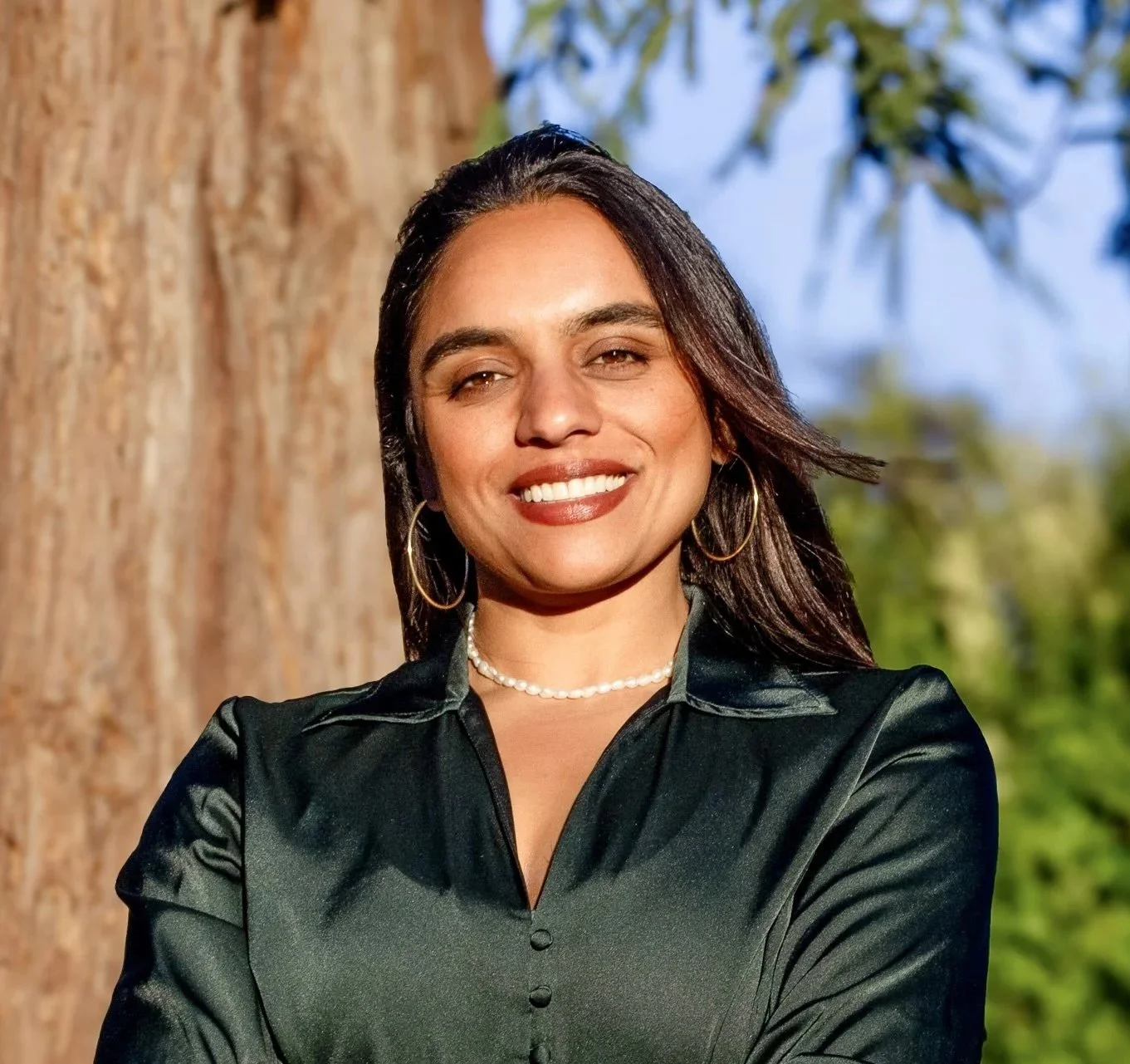
Janaki Anagha is a California attorney with over a decade of experience advancing legal and policy strategies focused on land, water, and climate justice. She earned her J.D. from the UC Davis School of Law and was a State Bar Environmental Fellow. Her work sits at the intersection of land use, water law, and local governance, with particular expertise in unincorporated farmworker and Tribal communities across California’s Central Valley. Janaki has served in senior roles at Community Water Center and California Rural Legal Assistance, where she enforced worker protections and advanced access to safe drinking water through litigation, administrative advocacy, and regulatory strategy. She is the creator of the Marigold Fund for Unincorporated California, where she supports community-led land stewardship and the development of new legal and ownership models for landless people. She serves as a Program Manager at the 11th Hour Project, where she grows equitable land access and resource flows within California’s food and agriculture system.
Dezaraye Bagalayos
Dezaraye Bagalayos is co-Associate Executive Director of the Allensworth Progressive Association. A lifelong community organizer and water activist, Dez is committed to California’s southern Central Valley where challenges of land, water, public health, food systems, and energy sovereignty are persistent and intertwined. Dez works as part of coalitions that strive for holistic community-centered relationships and justice-based climate resilience in rural communities. Through her leadership with the Allensworth Progressive Association, she aims to contribute to a revival in California’s Great Central Valley—grounded in solidarity, justice, and repair.
TRANSCRIPT
Faith Kearns
Hi everyone, welcome to Water Talk. Today we are talking about a large array of issues, but pretty focused on the Central Valley of California, and a really interesting conversation around some specific places and some very specific issues in the Central Valley. We talk about water philanthropy, and we talk about land repurposing and groundwater management, and really a lot about what communities envision for themselves and their futures in the Central Valley.
One of the things that you'll hear quite a bit about is unincorporated communities, which a lot of people may not be totally familiar with. The basic idea, right, is that an unincorporated community is not part of a town or a city. It's usually governed by rules that are developed for a county and generally is taxed at a lesser rate. And so that often doesn't have a lot of the resources that a town or a city that charges their own kinds of taxes might have for its residents. A lot of times unincorporated communities are pretty rural, people are spread out over large areas, and they just don't usually have access to a lot of the resources that most folks living in cities would think of. That's my primer. Mallika, Sam, do you have others that you'd like to add for this episode?
Mallika Nocco
Yeah, I was just going to say, when we're talking about visioning different types of ideas and how to change the landscape, we use a term that we haven't used on Water Talk before, but I'm sure you'll be hearing from us again, which is agrivoltaics. This is the idea of having energy production through solar arrays and then agriculture taking place on the same land. It could be just agriculture, like growing of crops, or it could be more of an ecological planting that's a part of the food system, or it could also be providing habitat for different creatures and providing services for communities like shade and cooling services as well. So agrivoltaics, you will hear that term. That was one thing.
Samuel Sandoval
And just a heads up, a fair warning that we're going to be talking about heat waves and their impact in farm workers. So just be aware for any of our sensitive audience.
Faith Kearns
Thank you both for that. And with that, we'll just jump right into our episode with our guests.
Welcome to Water Talk. In today's episode, we're talking about water and land stewardship in California's Central Valley with Janaki Anagha, founder of the Marigold Fund for Unincorporated California, and Dezaraye Bagalayos, a Central Valley water rights advocate and member of the fund's Axil Committee, and co-associate executive director of the Allensworth Progressive Association. The Marigold Fund is a participatory grant-making fund that supports community-led stewardship of land, water, and local economies in unincorporated California, prioritizing farm workers, small farms, and tribal communities. Janaki and Dezaraye, welcome to Water Talk. We're so happy to have both of you. You've been on our list of potential guests for a really long time, so it's great to have both of you here today.
Well, welcome to both of you. So, Janaki, you're a botanist and a lawyer who spent over a decade paying really close attention to California's unincorporated rural communities. That's not a topic that we've talked a lot about, so I'm super curious to hear. These are places you've described as quietly sustaining the state and beyond while being excluded from political power, capital, and basic infrastructure. So, can you talk a little bit about the Marigold Fund and what led you to start it, and what made you want to build something new as opposed to joining already existing efforts?
Janaki Anagha
Yeah, thank you, Faith, and thanks everyone for having us on. So the Marigold Fund at People Food and Land Foundation, and I should make sure that I say that several times for those who are listening, there are a couple of Marigold funds out there. So if you're looking to learn about this one, go to peoplefoodandland.org and navigate to the Marigold Fund there.
This fund came about after over 10 years of working in some of California's extremely remote rural communities, pushing for policy and legal restructuring that could help them to access basic things like land and water, basic things that we need to survive, like safe drinking water, for instance. And the Central Valley is this incredible place. I know I'm biased, but it's visible from outer space. It's this gigantic land feature and also a gigantic area of highly contested water resources that occupies this gigantic presence in our state. And it's full of people just doing the most outrageous things on the land, from gigantic sci-fi industrial agribusiness all the way to these incredible small communities that have eked out survival for themselves in the midst of what could be seen as a gigantic occupation of those natural resources.
As an attorney and a community legal services advocate over the last now 14 years, actually, I came to find that really state policy and state public programs were not necessarily reaching these small communities that are suspended in this huge Central Valley, this huge space within the state of California. And also philanthropic dollars are not reaching these communities either. All the while, the state of California, as an important beacon in the rest of the country, advancing some of our climate change policies and attempts to protect what remaining water resources are here, is kind of charging along down this path of putting those resources that are being made publicly available into the hands of things like large corporate entities that are continuing on the hamster wheel of agricultural production and expansion. And then also counties and cities, larger municipalities, that also don't necessarily serve some of these remote rural communities that have grown up out of this long story of agricultural development in California.
And it's reparatory. I use that word reparatory in the way of it being not necessarily a reparations framework, in terms of identifying the specific people that have been harmed and putting funding in their hands. But it is a reparatory method here, the creation of the Marigold Fund as a fund that I vehemently fundraise for. And then a group of steering committee members helps determine where those funds go, into the hands specifically of these unincorporated and tribal communities that have been forgotten, that have been left out and marginalized from this agricultural development and political development of the state. So that's really what the Marigold Fund does. It's focused on land and agroecological land management.
Mallika Nocco
Thank you so much, Janaki. And just as a follow-up, you've written before that California's Central Valley receives something like five to six cents of every philanthropic dollar that's spent in California, while LA and the Bay Area hold nearly 90% of the state's foundation assets. So the Marigold Fund uses a participatory grant-making framework to try to change that split. Can you explain to us how that model is actually working, and why putting the decisions in the hands of an Axil committee of local leaders, why that matters so much to you and to the fund?
Janaki Anagha
Yeah, absolutely. So I think let's start first by addressing the fallacy of philanthropy, which has to be spoken of here. I don't think that discussing grant making in any legitimate way should escape the critique of the genesis of this financing being the product of an inordinate accumulation by some party somewhere. Working in a family foundation, this is also not something that we deny as members of this field.
Furthermore, the United States, as an entity, has been involved also in philanthropy to white landowners since the dawn of the colonial project. Let's go back to the Federal Homestead Act of 1862, where the federal government just went ahead and gave 160 acres to each person who said they wanted it and stayed there for five years. And in this way, the country transferred roughly 270 million acres of Western land, about 10% of the entire area of the United States, into private hands, largely white land ownership during that time. So, insofar as the biophysical characteristics of our land masses are determined by who wins the race for land access, I think the origin of the financing behind that is somewhat beside the point, to me at least.
And as somebody who's looking at trying to move land out of speculation as fast as possible, given the constraints of the acceleration of corporate agribusiness and the acceleration of the drivers of climate change, my ethic here is to fundraise vehemently, as I said, and then to ensure that the people making choices over those dollars are neither of the billionaire class nor people of the federal government worker persuasion, right? We should place that decision making about those resources in the hands of people who live closest to that natural resource space.
And so I've been working with this team of women for many, many years now. It's called the Axil Committee because the axil part is a part of a plant, actually, that determines where new growth is meant to go. Many parts of the Marigold Fund have nomenclature related to botany.
Mallika Nocco
I love that. So wonderful.
Janaki Anagha
I'm glad you're tickled by it too. We love having a symbol to return to, to help guide the spirit of this work.
So Dezaraye, who's with us, and Nayamin Martinez of the Central California Environmental Justice Network, and Darlene Franco, who's the chairwoman of the Wukchumni tribe, these three incredible women who are in their own right working to advance agroecological land management projects over the course of many years, are the people who are actually determining where these funds are going at this time. Importantly, they have experience not just doing the land management work that is auspiced in their organizations, but they've helped build some of these entities in unincorporated communities from their primordial state into being flourishing entities that are now drawing in philanthropic, public, and other capital to help move towards greater land access and equity in the Central Valley.
So they are people who have some qualifications to be able to help nurture some of these other projects and biomimetically replicate some of these trajectories that they have helped initiate in different places and spaces and cultures across this beautiful and forgotten geography.
Samuel Sandoval
Yeah, thank you for that discussion. And Dezaraye, you're working on a plan that combines regenerative agriculture and agrivoltaics to bring energy independence and food sovereignty to the community of Allensworth. For many of our national audience, would you mind providing a picture of what is Allensworth, a little bit of the background?
Dezaraye Bagalayos
Absolutely. So Tulare Lake used to be the largest freshwater lake west of the Mississippi, and it was located, and still is, it's not gone. I call it now an ephemeral lake. Some people call it a ghost lake, I call it an ephemeral lake. Tulare Lake was drained and starved of its rivers at the turn of the century in order to open it up for agriculture. And Allensworth was the first Black founded and funded community, and it was founded on the southeast shoreline of, well, Goose Lake and Tulare Lake. There's two different lakes depending on how much water was on the ground.
In 1908, it was founded by a formerly enslaved colonel, as well as a professor from the Tuskegee Institute, as well as three other gentlemen. They wanted resiliency, they wanted self-sufficiency. This was during hardcore Jim Crow. They were looking for a safe place to raise their families, and education was a huge priority for them. So they wanted to establish a Tuskegee of the West, and they were going to do that in Allensworth. And the community thrived for a couple of decades.
But again, I know that California is often seen as a progressive place, but that's not necessarily our history. Basically, water contracts were not honored, and then the rail spur that was running in front of Allensworth, it really created a lot of the economic energy in the community. The neighboring white rural community was able to work with local politicians and with the railway to get that rail spur moved from Allensworth to that neighboring white community. So once those two things happened, and then the colonel, the colonel was run over by a motorcycle down in Los Angeles and Pasadena when he was down there negotiating some water contracts. So those three things combined really started it, folks started moving out of Allensworth.
But then as the decades have gone by, more South Americans, Central Americans, more of our Latino brothers and sisters came up and started working the lands, or coming back and started working the lands, Filipinos, Southeast Asians. California is super diverse, especially in the Central Valley. So now Allensworth is predominantly Latino. We went from the town that refuses to die to the town that chooses to thrive, that chose to thrive.
And like you said, our position is a solidarity economy model, cooperative development all around regenerative land stewardship. I'm really glad that you're bringing up agrivoltaics, because it's one of the things that a lot of us are really excited about. Because of the Sustainable Groundwater Management Act and its partnering initiatives, the multi-benefit land repurposing initiative that's going on, what we're seeing is a lot of people are considering scraped earth solar to be a green energy, multi-purpose project that can be done.
Well, we flat out, because we deal with tons of Valley fever, the highest rates of asthma, we do not consider scraped earth solar to be a green energy. And so we're looking at agrivoltaics, combining either habitat restoration or regenerative land stewardship practices with solar. That way we can create energy sovereignty and food sovereignty at the same time for our communities.
Faith Kearns
No, thank you, Dez. I really appreciate that. I think sometimes, especially from outside, but I think even within California, the Central Valley can be described as just a monolithic thing. And I think anybody who's spent time there and goes from place to place, just like Allensworth, there are lots of little Allensworth’s around with their own histories, their own future visions, their own agency, I guess. So it's nice to hear from both of you about some of those pockets that can help the Central Valley be seen as the really diverse and interesting place that it actually is.
And I know one of the other big issues facing probably all of us in the West and around the world, but the Western US does feel particularly prone to heat at the moment. So, Janaki, I know I've really been enjoying reading your newsletter, and we will put links for that so people can sign up for it in our show transcripts. But you've written a couple of pieces recently that were particularly focused on heat during the hottest part of the last few months. And you've talked about the heat impacts on farm workers in California, and I was surprised to see that farm workers die from heat exposure at 20 to 35 times the rate of other outdoor workers, right? We're not even comparing it to people who don't work outdoors.
We're talking other outdoor workers. And a lot of those folks live in these unincorporated communities that were originally built as farm labor settlements, and then they also don't have great tree canopy, they don't have great public investment, tons of asphalt and soil, which concentrates the heat. So can you talk a little bit about the heat and how these communities are coping, and just the impacts of heat on the Central Valley right now?
Janaki Anagha
This Mediterranean climate is really good for producing a large amount of agricultural products, but in terms of sustaining communities, it's one that requires a great deal of intervention in terms of ensuring that there is access to safe water and disaster preparedness. And over the course of the story of California, not once has there been a time that our state government or a federal government has looked inward, has looked down and looked at these communities and said, we're planning for all this agricultural profit, but we're not placing any of the same kind of decision-making power into these communities.
This is all to say, heat is just one of the many environmental challenges that are being contended with by these communities, because they are suspended as raisins in the sun in the middle of California. However, they're also places that right now, as we are in the process of looking forward, hopefully transitioning a significant amount of acreage in the Central Valley out of the kind of industrial water usage that has been compromising our groundwater resources, and also hopefully with support from things like the Marigold Fund that are meant to highlight and actually re-knit the social fabric that has been eroded by industrial agribusiness, we have an opportunity to think bioregionally. To really look at how some of these communities that are full of human beings, that are full of heart and ideas and sometimes equipment and actual readiness to engage with their local environments, how would they reimagine their landscapes to be places that have the trees that the local cities have that they don't have?
Mallika Nocco
Janaki, I think you just touched on quite a bit of this question, but just to ask it to you both in a little bit more of a formal way, we've been talking a lot about the Sustainable Groundwater Management Act, or SGMA, on this podcast. And we've been recently thinking about the land fallowing piece. I know you just mentioned that there is a significant amount of land, we hear numbers from half a million acres to a million acres thrown around, that will come out of traditional agricultural production in the Central Valley.
Building on what you just mentioned about communities visioning what they want some of this land to look like or how they want this land to function, how can we think of that fallowing not as a loss, or just a loss, but also as a chance to bring shade or water or health to places that need it the most? Like what you're talking about, how could we turn the fallowed farmland into cooling infrastructure? How could we turn it, potentially, into agrivoltaic infrastructure, community forests, shaded public spaces? Can you both comment on that fallowing idea specifically? I don't know whomever would like to start first, to think about the fallowing and the transformation.
Dezaraye Bagalayos
I'll start. I've always been pretty critical of the Sustainable Groundwater Management Act, since I started reading drafts back in 2013 and '14. How I read it was that it was going to consolidate land into fewer hands and that it was going to create the conditions for water markets. And that's what we're starting to see. We're starting to see more land go up for sale as well, because we, the APA and the community of Allensworth, we're in hardcore land acquisition mode. And I think, like a lot of communities, a lot of organizations in the Central Valley doing work within this area, we're all looking at land acquisition, because in order to have a say about water and how water is managed and how water is allocated, you have to be a landowner. So how do you become a landowner when the real estate is just as racist a system as any? And then also, how do you practice land ownership in a more equitable way?
What we don't want to see is we don't want to see data centers. I have to say that I've been really happy to see just the general reaction to proposed data centers, especially down here in the South Valley, because we're considered one of the most conservative areas in the state of California, politically speaking. But seeing people just really come out and say no, and I mean this is across political spectrums, people do not want data centers. We don't want more prisons built out here. We do not want detention centers built out here. We do not want Amazon warehouses built out here. We do not want non-climate-resilient tract homes to be built out in the landscapes, right? In Tulare County alone, we have less than 5% of our riparian habitat left intact. We need land restoration. We need to start healing our soils. We need to give a lot of this land back to itself and to the tribes that stewarded these lands for thousands of years before colonization came along.
So there's lots of land that will be retired or will be fallowed. And there's a lot of folks that are really, really waiting for the real estate market to catch up to reality, because it hasn't. It's just been in the last year or two that the groundwater sustainability agencies have started levying fines. So we're starting to see a lot more lawsuits. We're starting to see a lot more people say, we're not going to play, we'd just rather go to court. And you're starting to see these really heavy fees and fines that are being levied. And so the prices of real estate haven't quite reached the reality of the water situation and how much water is really attached to that land. I'm curious to see how things play out when that actually happens.
We're heading into times where there is so much room for possibility, for us to make real determinations about the future of the Central Valley and what our communities and what our landscapes are going to look like. And there's a real energy out here. You feel more and more people picking up and being like, hey, we want to be a part of deciding how these things go now and what's going to happen. And then we also have the intense pressure of climate change, which I just don't really hear very many Californians and people in power in California really talking about. It's so mind-blowing to me. But it's also not mind-blowing, in the sense that I feel like the Central Valley has been treated like a sacrifice zone. They will extract as much as they can from the land and the people, and then once there's nothing left to extract, they will go elsewhere. Well, no, the people, our communities and the people and families that are living here, we don't interact with our land and our communities that way. We're not going anywhere.
So we really are looking at, a lot more of us are looking at cooperative ownership of that land, and then fundraising for land acquisition and coming up with really creative partnerships with tribes and with other organizations on how can we get together, how can we navigate these systems and all this red tape together to our own benefit and to the benefit of our communities and our landscapes. So we do see what's happening because of SGMA as an opportunity, but it's not just an opportunity for us. Not only are we always having to go after those opportunities and find really, really creative ways to access them, we are also having to fight off the powers that be and push back really, really hard on their agenda.
Mallika Nocco
Thank you so much, Dez. What about you, Janaki?
Janaki Anagha
I think SGMA was passed with the intention of buying time. And to harken to the AI data center item that Dez was talking about, we're also in that moment right now where there's a moment of great collapse and fear. There's a desire by communities to think about how to make this work, right? And SGMA, that's all SGMA really does. It has a 2040 deadline to even show sustainability in terms of use of groundwater. And is it actually stopping the overuse of groundwater? It's kind of hairy for us to be able to say cleanly yes or no on that. Our decision-making structures around natural resources in California are an antiquated approach to our ecologies. They're a relic. And SGMA did not actually help change that. The only thing that will help change that is an advancement in our local democracies, and that comes about through our local communities being equipped to actually participate, to have the time and capacity to imagine, to be able to open up the treasure that is their lived experience in partnership with the land, to be able to offer those learnings and gifts to the way that we actually manage natural resources in California.
That is really the only answer I can provide around how do we hold SGMA, the Sustainable Groundwater Management Act, in check through this land transition process. We have to recognize there is a moment of collapse. There's a moment of collapse of our groundwater resources in California. It's visible from outer space. We see subsidence from NASA imagery. We're seeing this big gash in the middle of California from so far away, in the same way that we see the Himalayas and the Nile Delta. Let's realize the immensity of this region and its significance on the face of the planet, and then do our best to dive into the places where people are actually living in this big gash and equip them with the ability to enact some of their imaginations about solutions.
And I don't want to leave this question without actually elevating what at least one of those solutions looks like. In the town of Fairmead, which is a small community in Madera County, this is another very high-ranking agricultural county in the state of California, which again is the biggest agricultural state in the United States, a small unincorporated community has their neighborhood association called Fairmead Community and Friends, and they have gone about partnering with a bunch of local nonprofit organizations and a set of local farmers, after a long struggle with their county as well, to establish a community groundwater recharge site. This means that they have a big basin now where water that falls from the sky during our storm times can actually go to recharge their community aquifer, which is their source of drinking water and domestic potable water.
It's incredible to me when I come back from visiting with that community. I just have to lie down and stare at the ceiling for a while, because I'm like, these people have actually gone about changing their local hydrology, changing their local topography for survival. They're just people out there changing the face of the earth to ensure that they have a way to make it through the coming years that are showing us very clearly that society at large is much more interested in riding the arc of collapse. Our attention is much more drawn to stories of collapse than to the mycelial and microscopic stories of survival and recreation that are happening. Whether we look at them or not, they are happening. And they're happening in the Central Valley at an incredible clip.
I just want to highlight that it makes sense, right, that there are companies reaping billions of dollars off of general society writing this storyline that we know captivates the hearts and minds of a wide segment of the American population. We've all seen Marvel movies. But at the same time, there are community residents who have built, upon every year that they've spent in relationship to these natural resource bases in which they live, they are creating these stories for themselves of how they will outlive this decade of fear and the decade of fear that will follow that. Allensworth is an incredible example of that. Fairmead, the women of Fairmead Community and Friends, an incredible example of that, and all of the Marigold Fund grantees that you can check out by going to peoplefoodandland.org and navigating to the Marigold Fund.
Samuel Sandoval
Actually, well, first of all, thank both of you, Janaki and Dezaraye, for all your thoughts and for this conversation with us. Also, two questions. First, is there anything else that you want to share with our audience that you haven't shared? And the second one, how can we support your work?
Janaki Anagha
Yeah, I can start and maybe Dez can close us out. But yeah, I really, really appreciate you all for having us on and having this chance to talk about not only climate change adaptation and mitigation as it's often framed in government and frankly in a lot of water policy spaces, but rather having this conversation about how to partner with the non-human world to create life as opposed to submitting to the non-human world in its destruction. I think that's really at the heart of what the Marigold Fund is seeking to do in bringing people together, because people and our political structures are really the key to healing many of the concerns that we see government agencies flailing to try to solve in the Central Valley.
And in terms of how to support this work, absolutely would love for you to go to peoplefoodandland.org and navigate to the Marigold Fund. My contact information is embedded in the concept note that you can download there and get in touch with me. And I will also hope that the hosts here will share any of that information and follow the Substack at Marigold Society.
Dezaraye Bagalayos
All right. And I'll just say, I've been saying this a lot lately: the Central Valley is a sacred place. It is a sacred place. And we're all treating it and interacting with it as if it is that sacred place as we do this work. I know that you told us to think about the audience that we're talking to right now. There's a lot to despair, right? We're all contending with a lot on multiple, multiple levels. And I would just say, wherever you're at, just steep yourself and your community in the work and the needs that are happening in and around your community. There is something to be done everywhere.
And just to bring it back to the Central Valley, I will say this. The Central Valley is the heart and the backbone, and so many of the important internal organs that keep a body moving and living and breathing. We are that to the state of California, and we know what the state of California is to the rest of the world. And so I really urge Californians that are not living in the Central Valley to start learning about the role that the Central Valley plays in the wealth and in the benefits of living in the state. And again, to support us in our work, just learning about the Central Valley, learning about our communities, that's a really, really great step. Going to People, Food, and Land and checking out the Marigold Fund and all of the wonderful work.
Super grateful for Janaki for inviting me onto the Axil Committee with Darlene and Nayamin. And the same when Faith invited Janaki and me onto Water Talk. Being able to be in conversation and to be steeped in the work with these incredible people, it means a lot. This is the work that needs to be done now. We are at that crossroads. And so just finding the joy and creating relationships with your neighbors and with neighboring communities and with the other folks doing this work. And just holding on to each other and holding on to the land.
Faith Kearns
Thank you both. We really appreciate you being here. Appreciate your time, appreciate the work that you're doing. So thank you again. It was a joy to talk with both of you.
Well, that was such an interesting conversation. I'm wondering what both of you have for your parting gifts in our conversation.
Mallika Nocco
Well, just to start on a light wave, I loved all of the botany connections that were made, and just the combination of these really interesting community-driven ideas, and then interfacing them or placing them in this plant-y language really, that touched my heart for sure. What about you, Sam?
Samuel Sandoval
For me it was centering a lot of the conversation on the people and the different communities that they talk about. There were plenty of other things related with SGMA and other policies that I think are important. But the portrait that they put of the different communities, the resilience of communities, and some of the comments of Dezaraye, that communities that are resilient, communities that want to be there, that are proud that it's a sacred place, and that perhaps the message that regardless if it is putting food in our basket or others, these are communities that deserve a fair treatment regardless of trying to bring any purpose to them. I think every community is sacred, and how to maintain it. So that was my parting gift. What about you, Faith?
Faith Kearns
I think for me, especially talking about community agency and seizing the moment that is now, I just want to broaden it out to say that while this is happening in the Central Valley, I think it's something that's also happening in other places. I spent the last couple of years doing a bunch of groundwater community work in Arizona. And it was super interesting because I could feel the energy of our conversation. It was taking me back to being in these rooms with people who are living in unincorporated rural communities in Arizona and who are so creative and so dedicated. Even though this is a time when there's a perceived lack of resources coming down, particularly from the federal level, I could see in these settings people just turning to each other and going, okay, if we're on our own, what are we going to do? And then just seeing this new energy come from the sense that we all have to save each other, right? That was very much the energy I got from the conversation with them as well.
I just think it is a beautiful energy to witness and to be a part of. And like Dez was saying, get out and be in your own community and do what's necessary in that place. I'm seeing people do it everywhere, and it's a really inspiring thing to watch. So I really appreciate them coming on. And thank you to everyone for listening to Water Talk.
Mallika Nocco
Thank you for listening to Water Talk. If you enjoyed our podcast, please like, subscribe, and give us a great review. Original music by Summarth Rao.